
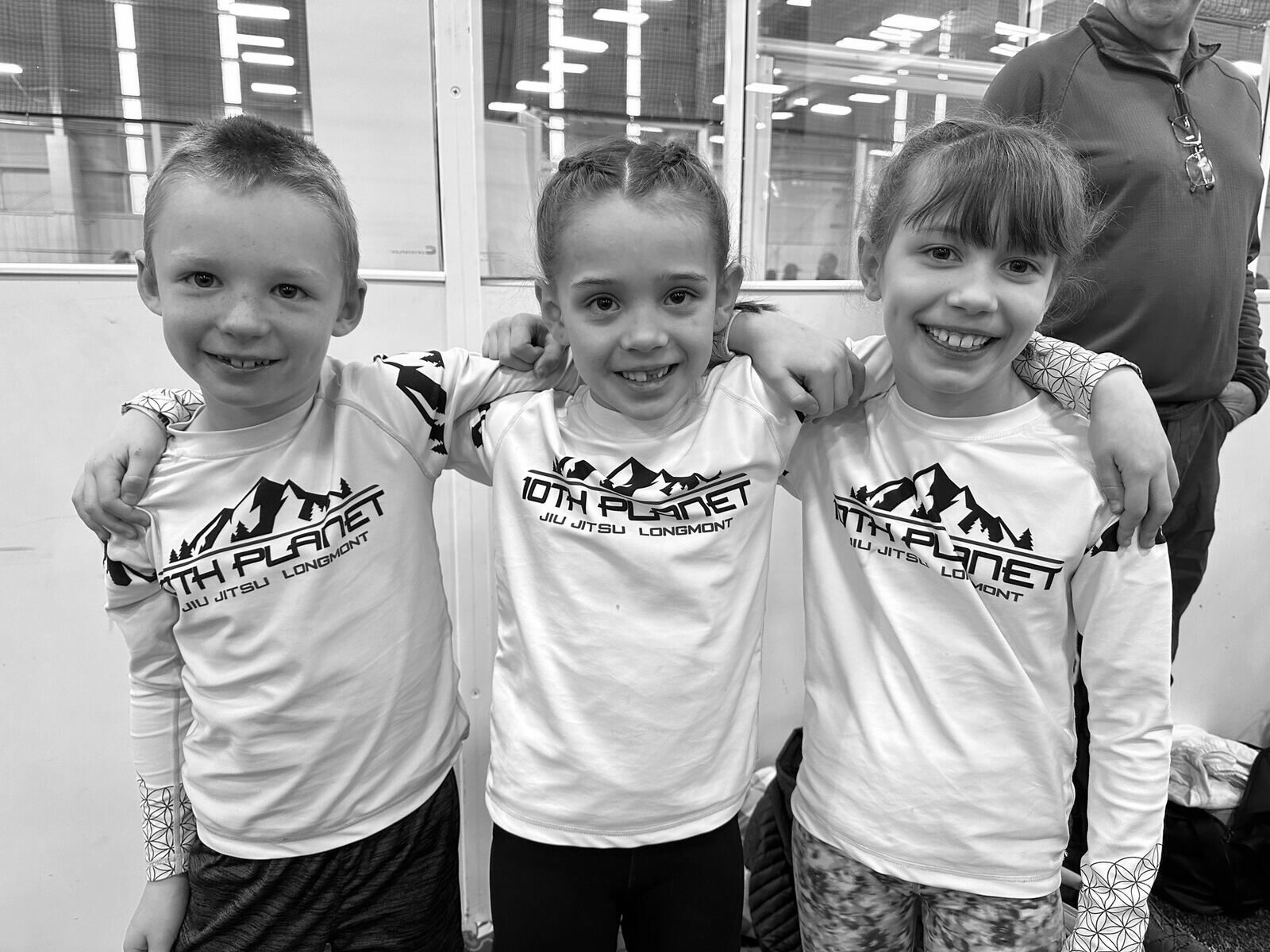
If you're a parent looking into martial arts for your kid, you've probably run into this question: karate or jiu jitsu?
Both are great activities. Both teach discipline, respect and confidence. Longmont has excellent schools of both kinds. But they teach very different skills, and the right choice depends on what you want your child to get out of it.
Obviously I'm biased. I run a jiu jitsu school. So I'll do my best to give you an honest comparison, and you can decide what fits your family.
The core difference: striking vs. grappling
Karate is a striking art. Kids learn punches, kicks, blocks and stances. Training is built around kata (choreographed forms), drills, and in many schools, point sparring where a match stops after a clean strike lands.
Jiu jitsu is a grappling art. Instead of punching and kicking, kids learn to control another person: taking them down safely, holding them in place, escaping from underneath, and finishing with a submission (a hold that makes the partner "tap" to stop). There are no strikes in kids jiu jitsu.
That one difference shapes everything else.
What karate does really well
Let's give karate its due:
- Coordination and form. Kata builds balance, precision and memory.
- Structure and tradition. Bowing, uniforms, formal belt tests. Many kids thrive with that clear structure.
- Discipline and focus. Holding stances and repeating forms takes real concentration.
- Clear milestones. Belt promotions in many karate schools come at a steady pace, which keeps young kids motivated.
If your child loves structure, rituals and visible progress, karate can be a wonderful fit.
What jiu jitsu does really well
Here's where jiu jitsu stands out, and why a lot of parents end up choosing it:
1. Kids practice against real resistance
In jiu jitsu, kids don't just practice moves in the air. They practice against a partner who's actively trying to stop them, at a safe, controlled intensity. That's called "rolling," and it's the heart of the sport.
It matters because a technique you've only practiced in the air is a technique you hope works. A technique you've used against a resisting partner hundreds of times is one you know works. Kids feel that difference, and it's where their confidence comes from.
2. It's built for the kind of bullying kids actually face
Most schoolyard conflicts aren't kickboxing matches. They're shoving, grabbing, headlocks and getting pushed to the ground. Jiu jitsu teaches kids exactly what to do in those situations: how to stay calm, get out from under someone bigger, and control a situation without hurting anyone.
That last part is a big deal for parents. Many schools have zero-tolerance policies on hitting. A kid who knows jiu jitsu has options that don't involve throwing a punch.
3. Size matters less
Jiu jitsu was built around leverage and technique so a smaller person can handle a bigger one. Kids learn early that being the biggest or strongest isn't what wins. Smart positioning is. That's a great lesson for smaller kids and a humbling one for the big ones.
4. It's a full-body workout disguised as play
Rolling is tiring in the best way. Kids build strength, flexibility and endurance without it ever feeling like exercise. It also transfers to other sports. Wrestlers, football players and soccer players all benefit.
5. Problem-solving under pressure
Jiu jitsu is often called "physical chess." When a partner is on top of you, you have to stay calm and think your way out. Learning to stay composed when things are uncomfortable is a skill kids carry into tests, competitions and everyday life.
Quick comparison
| Karate | Jiu Jitsu | |
|---|---|---|
| Main skill | Striking (punches, kicks, blocks) | Grappling (takedowns, control, escapes) |
| Sparring | Often point sparring | Live "rolling" against a resisting partner |
| Self-defense focus | Distance and striking | Control, escapes, staying safe on the ground |
| Contact in kids classes | Light, often limited | Close contact, controlled and supervised |
| Uniform | Traditional gi | At 10th Planet: none, just athletic clothes |
| Best for kids who… | Love structure, forms and visible milestones | Love wrestling around, problem-solving and hands-on play |
What about "no-gi" jiu jitsu?
Traditional Brazilian jiu jitsu is trained in a heavy cotton uniform called a gi. At 10th Planet, we train 100% no-gi, in regular athletic clothes like a t-shirt, shorts or a rash guard.
For kids, that means there's no expensive uniform to buy before they know if they like it. It also means they learn to control a partner without grabbing clothing, which is closer to real-life situations.
Can my kid do both?
Absolutely. Plenty of kids do. Striking and grappling complement each other well, and many mixed martial artists started in one and added the other. If your child already does karate and wants to try grappling, jiu jitsu fills in exactly the skills karate doesn't cover.
The best way to decide: try a class
Reading about it only gets you so far. Watch your kid in a class and you'll know within 10 minutes whether they're lit up or checked out.
Our kids classes at 10th Planet Longmont are split by age:
- Tots (ages 3–5): game-based, no sparring, all about listening, coordination and confidence
- Kids (ages 6–10): real jiu jitsu fundamentals, escapes, and anti-bullying self-defense
- Pre/Teen (ages 11+): great for beginners, athletes and wrestlers alike
See the full class schedule, read more about each program, or grab our free Parent's Guide to Kids Jiu Jitsu.
Your child's first class is free. No uniform, no experience and no pressure. Book a free trial and a coach will reach out to help you pick the right class.
We're on Hover Street in north Longmont and see families from Niwot, Mead, Firestone & Frederick and Erie.
See you on the mats!